World Finance Directorate
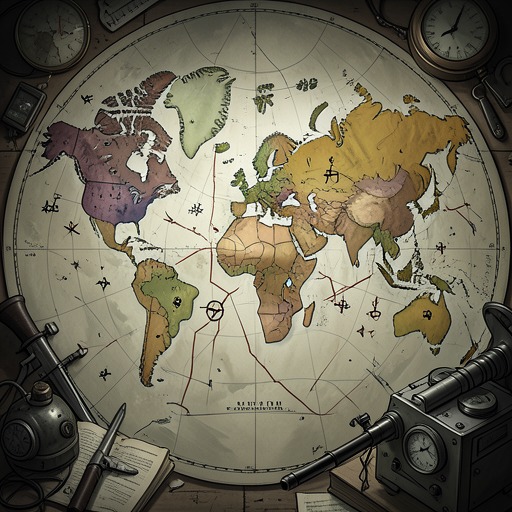
Last and First MenThe World Finance Directorate was the governing institution that turned a wartime bargain between the United States and China into a global political order. Although it was presented as a practical means of coordinating economic reconstruction, it became the First World State’s actual seat of power: a small circle of financial magnates stood above its industrial councils and their claims to democratic representation.
Origins in rivalry and resource politics
The Directorate’s formation grew from conflicts that made economic interdependence a source of political danger. In Russia, communist doctrine survived even as American finance steadily reshaped communist practice. Germany, though less individualistic than the United States, became the symbol of capitalism in the Russian mind; the antagonism helped prepare the ground for the Russo-German War. Competition over Russian oil added a material stake: Germany had been displaced from a profitable field by American capital, while the United States sought to secure Russian supplies and compete with sources under Chinese control. As oil grew scarce, control of remaining fields became a major cause of international conflict.
The later rivalry between the United States and China likewise joined economic interests to opposing visions of world order. After the Euro-American War came a century of lesser conflicts, followed by a century of strained peace. The League of Nations had imposed cosmopolitan control over oil and coal, but newly workable fuel deposits in Antarctica fell outside the World Fuel Control Board’s jurisdiction. The United States moved first to exploit them; China, fearing the spread of American influence, demanded that the new supplies be placed under international control. With both peoples again drawn toward nationalism, war became increasingly likely.
The Pacific agreement
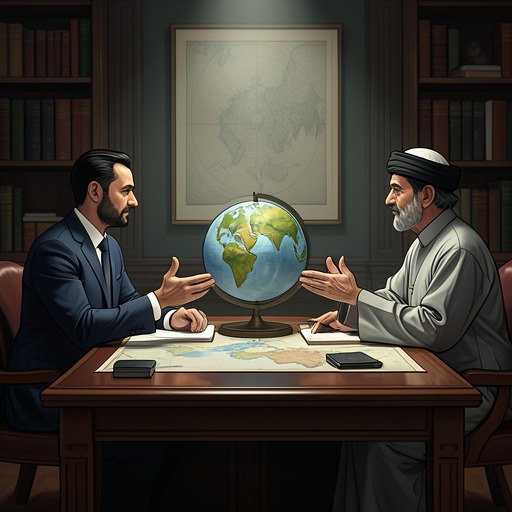
In the twenty-sixth year of the war, American and Chinese envoys met on an Island in the Pacific. Their negotiations were amicable because they agreed on the practical measures: the national governments in both countries were to be overthrown simultaneously, and a World Finance Directorate would take their place. The proposed body would bring together leading commercial and industrial magnates with representatives of workers’ organizations. The American envoy was to become its first president and the Chinese envoy its first vice-president.
The Directorate’s remit reached beyond settling the immediate dispute. It would direct the world’s economic reorganization, bring industrial conditions in the East into line with those of the United States, and end the American monopoly over Antarctica by placing the resource-rich, lightly developed land under its control. The negotiators acknowledged the cultural distance between East and West but treated it as secondary to the business of reorganizing the planet. Their confidence that finance and the people could support simultaneous change proved central to the transfer of power.
From negotiation to world government
The transition from competing sovereignties to Directorate rule came through coordinated action in the United States and China. In China, the process was almost immediate and bloodless. In the United States, the government tried for several weeks to suppress the rebels through martial law, but a population eager for peace and the passive resistance of cosmopolitan big business made the opposition irresistible. After limited casualties, the governing clique collapsed. Roughly three hundred and eighty terrestrial years after the European War, the goal of world unity had thus been achieved, though the race’s capacity for sound judgment had already been seriously weakened.
The resulting system resembled guild socialism while remaining individualistic in its distribution of power. Each industry was nominally governed democratically by its members, but dominant individuals controlled it in practice. A World Industrial Council coordinated the industries, whose standing reflected both economic strength and public esteem. This produced an inner circle of prestigious industries, including Finance, Flying, Engineering, Surface Locomotion, Chemical Industry, and Professional Athletics. Yet neither the council nor its prestigious inner ring held final authority. Power rested with the World Finance Directorate, a committee of twelve millionaires headed by the American president and Chinese vice-president.
Internal conflict and political symbolism
The Directorate’s leadership was not free of factional struggle. Soon after the system began, the vice-president tried to displace the president by publicizing his connection with a Polynesian woman known as the Daughter of Man. The president did not deny the relationship. Instead, he presented it as evidence that his private identity had been enlarged into a capacity to represent the world, while maintaining that his private moral life remained distinct from his public office.
The episode transformed a challenge to the president into a spectacle of political unity. His account was broadcast by microphone, and the Daughter of Man’s image was transmitted by television across the world. Her face, described as combining Asia and the West, became a potent emblem of shared human identity. The president’s response helped preserve both his position and the unity of the new order, but it also revealed how authority could be secured through a blend of personal power, financial control, and symbolic representation.
Power and its limits
The Directorate’s defining achievement was to supersede national governments with a single coordinating authority, while its defining contradiction was the gap between global representation and concentrated control. Workers’ organizations had places in the proposed body, industries were said to govern themselves, and a council coordinated production; nevertheless, a dozen millionaires formed the real center of rule. The world’s resources and industries were integrated under institutions whose language promised participation but whose practical authority remained with financial leaders.
That order also arose from a resource crisis it could not permanently solve. Fuel governance had become a central task of international politics, and the new world system inherited an economy still dependent on finite supplies. Centuries later, the First World State’s civilization collapsed when even Antarctica’s coal deposits were exhausted. The Directorate’s founding had achieved political unity, but unity alone could neither abolish material limits nor guarantee that a society would respond wisely when those limits arrived.